Showing posts with label Geralt of Rivia. Show all posts

Wednesday, September 11, 2024

MIDI Week Singles: "Dusk of a Northern Kingdom" - The Witcher: Enhanced Edition (PC)


"Dusk of a Northern Kingdom" from The Witcher: Enhanced Edition on Windows and Mac (2007)
Composer: Adam Skorupa
Album: The Witcher -Role Playing Game- Original Soundtrack
Label: CD Projekt RED
Publisher: CD Projekt, Atari
Developer: CD Projekt RED


What I like a lot about this piece is that it's a great snapshot of the world of The Continent and The Witcher series.  There are themes here that are present throughout the pieces that Adam Skorupa wrote for the soundtrack along with Paweł Blaszczak, but it helps to make the world feel more cohesive than a solo stand-alone theme that you only hear at the beginning of the game.  With themes comprised of and dotted throughout "Peaceful Moments," "The Princess Striga," and "Do You Remember," (among others), you really get a feel for this world and its lore.

That's really it.  Great song that captures the essence of the first Witcher game that, at least I think, carries through through The Witcher III.


~JWfW/JDub/The Faceplantman/Jaconian
Instrumental

Friday, April 10, 2020

First Impressions: The Witcher III: Wild Hunt (NS)


Just a quick preface.  This is going to be a weird article, both in the writing and the presentation.  The Witcher III: Wild Hunt was released in 2015 and received a few awards, even two years before the game was released.  A Google search brings back more than one million results, with roughly 875,000 when doing a boolean search including Nintendo Switch.  What can I offer from our little corner of the web that hasn't already been done before?  Honestly, probably not a lot aside from an opinion that is my own.  And presently, I have put in about 55 hours, which some might consider too long to be starting in on my First Impressions, but there is a lot to unpack here, not just in the context of this being the third part in a series, but also because there is a brand new to The Witcher series engine being used here.

I have mentioned it before, but just to reiterate where I am coming from as far as my Witcher lore is concerned.  I played the first game on PC back in 2017 and enjoyed the bejeezus out of that.  I then read the first chronological book, The Last Wish probably the late fall/early winter of 2017,  this being my primary introduction to Yennefer of Vengeberg (I think she must have been mentioned in The Witcher, but that game seemed more focused on Geralt choosing between either Shani or Triss rather than his past relationships).  Then I started up The Witcher II: Assassins of Kings on PC in late 2019 and finished it in March of this year.  Conklederp and I also watched the series on Netflix over Christmas and then did a rewatch back in February.

So I feel that this article is primarily going to be a lot of comparing how I feel The Witcher III both compares to the first two games, and what I like about the changes, what I think works, and what I (at the present) do not like about the game, because there are some aspects that I am not a fan off, which is to be expected when a game in a series uses a new engine and establishes new mechanics.

Mechanics-wise, I feel like, for me, the biggest changes between The Witcher III and the previous two games involve Geralt's skills and how he learns them, and the equipment degradation system.  In the first two games, when you spend points you earn upon leveling up, you learn that skill and it is effective permanently.  In this game when you start out, your skills have been reset from where they were at the end of the second game, which makes sense, even if you were importing a save file from The Witcher 2 (which you cannot do on the Switch), which does not bother me at all.  What bothers me is that when you do start out, you only have one slot to equip a skill beyond the signs you start with.  What if feels like CD Projekt is doing is limiting how powerful Geralt can become and instead create a skill management system based on what you are doing in the game.  Going into a town, better change out the developed Igni skill for the Axii skill because you may need to convince someone rather than setting them on fire.  Except that there is no way (that I have found anyway) to have a quick loadout swap which would be immensely useful.  For me, I would have a loadout for when I am out exploring the world and know that I will probably need attack-based skills equipped, and a different loadout for when I am in a city and primarily interacting with people through dialogue rather than a steel sword.  In the early game, I found it daunting swapping out the "Survival Instinct" skill (which adds 500 vitality to the starting amount of 3500, which is pretty substantial in the early game) and Axii's "Delusion" skill, which you can sometimes use to give you additional dialogue options.

The equipment degradation system is also a completely new mechanic to the series and one that I am increasingly getting more-and-more used to in the context of The Witcher series.  Diablo, Legend of Zelda: Breath of the Wild and Dark Souls all have weapon degradation mechanics in place, so after a while, you either have to get the equipment repaired or it will permanently break.  In the early game after you leave White Orchard and are in Velen and are immediately ostracized by nearby towns who are leary of doing any kind of business with the one who attacked/killed the Baron's men, finding a weapon or armor repair kit was frustrating.  When in White Orchard, I was able to just head back to Willis to repair anything I needed, although I still had to be picky because even then I was not rolling in the Crowns, but after leaving White Orchard, that kind of service was hard to come by.  I often found myself fast traveling back to White Orchard (which is a completely different area/map) just so that I could get my equipment repaired.  Like a stereotype in video games, I put the urgent main quest on hold so Geralt could travel the couple of in-game days it takes to trot from White Orchard to Velen and back because of the integrity of his current silver sword and armor has degraded below 50%.  And while you do find swords and armor all over the place, it does not feel like the developers want you to experiment with other gear like you do in Breath of the Wild.  While I was not really a fan of this type of mechanic being introduced into the series in the way that it was, I am not of the financial position that I am able to buy repair kits every time I go to town and have a little supply going.


Speaking of weapon degradation, combat is something that is still taking a bit to get used to, even after 50 hours.  What I loved about combat in the first Witcher game was that you had three different fighting techniques with each sword, allowing you to say, attack a group of soldiers using group attacks, then switch to either strong or swift attacks after you have thinned out the group a bit.  The game would move Geralt in a way that made the attacks look more like a choreographed dance than the button-mashing attacks in The Elder Scrolls series.  In The Witcher 2, combat became more complicated (at first) with the inclusion of throwing bombs and knives and using multiple signs in the same battle, having to adapt on-the-fly against multiple types of enemies, but by the end of the game, I was fairly fluent and probably could have increased the difficulty beyond Easy.  Combat in The Witcher III is. . .different.  To say nothing of fighting a dragon at the end of The Witcher 2 to being killed when attacked by two Drowners in The Witcher III.  It also does not feel like there is as much oomph behind attacks and I often feel like I am button mashing more between either light or strong attacks.  I also have a hard time determining distances Geralt can travel when making attacks, oftentimes going in for a strong attack (which includes a lunge of-sorts) and just completely whiff the attack.  There is also a modified dodge mechanic that is now Geralt rolling out of the way like he is in a Dark Souls game wearing light armor.

Another criticism I have and one that I have had throughout the entire Witcher series is how the inventory screens are presented and handled.  One of the key mechanics in this series is that Geralt (as do other Witchers) brews his own potions, oils for his sword, new to The Witcher III are decoctions which augment Geralt's abilities against specific creature types, and creating bombs to use in and out of combat.  Having so many different crafting options, it makes sense that the inventory screen would be full of flowers picked for their alchemical purposes, materials scavenged from corpses and shipping containers to construct into gear and the like.  But looking at the various screens can be overwhelming.  Like, I might know what beggartick blossoms do in the context of the game, but I am not going to remember what the icon for them looks like, especially since I have primarily been playing in handheld mode.


You know what, let us address the crimson elephant in the room.  The card game of Gwent, introduced in this game, but happens to be a game that everyone and their mother now plays in the continent.  I guess a card game would be more engaging than the game of dice poker that is played in the first two games, and while I did tool around with the beta when it was first being released/distributed through GOG, I never did put a lot of time into the game itself.  So when I started this game, I was kind of excited to see how things went here, playing against computer characters with their own decks.  The moment I drew the Zoltan Chivay card and the Ves card, I was immediately taken out of any immersion I had been experiencing.  For my own liking, there were too many cards referencing in-game characters that, to me at least, did not make any sense.  Sure, in an online trading card game it would make sense to have cards based on familiar characters, but to have a card representing either Dethmold or even Keira Metz seemed silly, especially in-game.  Is Keira Metz really that well known of a person in-game to have an officially recognized Gwent card made in her image?  How is there no black market underground Gwent ring with people using whatever cards they can make up?  "Oh, yeah, that Sorceresses Lodge card is totally real and valued at 15 for Ranged Combat.  Yeah, no, fur sure!" To date, I have played fewer than 10 rounds of Gwent, and the last time was to win back some documents lost to a Dwarf outside of Novigrad.  Although shortly after this quest, I decided that I would start buying more in-game Gwent cards just in case there were more quests that required Geralt to play Gwent in order to proceed.  But I am not going to like it; and at least there is a setting in the options to lower the overall difficulty of Gwent battles to Easy whereas I currently have it set at Normal/Medium.


Lastly (for now anyway), and just to be kind of nit-picky, is that I am not all beside myself for Geralt with a beard.  It is probably because I spent the last 125 hours over the course of the two previous games with beardless Geralt, but it is just something that I think I am just not used to.  Yet, anyway.  I have heard that he can get it trimmed after the initial trimming/interrogation in Vizima, but I have yet to find a barber, even in Novigrad (although I am far from finished exploring Novigrad).

I probably played fewer than 10 hours before the quality-of-life upgrades that were part of the patch on February 20th (Update 3.6 for those of you keeping track).  After that update, I did switch off Blur and Anti-Aliasing which did make some of the lines in-game more pixelated, but it did remove a lot of the blur.  Personally, I like the look of the game on the Switch (in handheld) with Blur and Anti-Aliasing turned off, and I am even more impressed at how in-depth the graphical settings are in the game, considering it's on a console and this level of options are usually reserved for gaming on a PC.

You know, I can understand by the tone of most of this article that I am hating my time in The Witcher III: Wild Hunt, but that is pretty far from the truth.  I definitely would not have put 50+ hours into a game if I was not having fun.  I really do love this world, the characters, and I am excited to see what happened to Zoltan, Dandelion, Triss, and how the story and choices I made in the first two games affected how this game is playing out.  Well, here is to another 55+ hours in this world!


~JWfW/JDub/Cooking Crack/Jaconian

The Picture's Crystal Clear and Everything is Magnified

Thursday, March 19, 2020

MIDI Week Singles: "Geralt of Rivia" - The Witcher III: Wild Hunt (NS)


"Geralt of Rivia" from The Witcher III: Wild Hunt on the PC, PlayStation 4, Xbox One, & Nintendo Switch (2015 & 2019)
Publisher: CD Projekt
Developer: CD Projekt Red


You know, I think this song came up right when I needed it to this afternoon.  Being my first day working from home during this time of sheltering in place and public isolation, hearing the heroic fanfare of one Geralt of Rivia was very welcome.

What is interesting is that the entire song is not as grand or epic as the last minute, but you do hear Geralt's theme from the beginning played softly and as the song progresses there comes an added darkness and foreboding.  All of which suits well for the character of Geralt as he is not your typical heroic figure.  Despite the fact that his profession is that of one that helps people, he often comes across as a reluctant participant in his own story.

It is pretty easy to let the first half of this song slip by, which is not meant as a slight, just that the song itself is somewhat serene, even during the darker war-torn section in the middle, but at 1:27 Geralt's theme is revamped into something that nearly everyone who has played any game in the series might see him as.  The hero, all victorious and such.  Maybe it is a little too cheesy, but right now, this is what I need.


~JWfW/JDub/Cooking Crack/Jaconian
Born of Kaer Morhen

Friday, March 6, 2020

Game EXP: The Witcher 2: Assassins of Kings Enhanced Edition (PC)


So after 49 hours and 10 minutes, I finished The Witcher 2: Assassins of Kings Enhanced Edition through GOG's Galaxy client back on the first of this month.  Within the hour, I then booted up The Witcher III: Wild Hunt on my Nintendo Switch and started in on that little 170+ hour game without a glance back.  What I should have done was sit down and put down my recent thoughts into words like I am doing now, but this will have to suffice.  And because I am going to be talking about key events that take place in The Witcher 2, you should expect there to be spoilers coming.  And I apologize for the length of this article as I did try my best to keep in condensed, but since we go into the reason for the key decisions I made in the game, I felt that I needed to give context to those decisions which lead down a Nekker hole or eight.

I started playing The Witcher 2 back in November and gave my First Impressions shortly thereafter.  At that time, I was still a little unsure about a lot of things, primarily the story and where it was going, as well as the new updated combat system.  I can tell you now that by the end of the game, I was full in on both in most respects (throwing daggers/bombs I still found myself rarely doing as targeting was odd, to say the least).  Because this is a Game EXP article and not a full-on review article, I am going to pass over a lot, but since this game was originally released back in 2012, there is not a lot of analysis that I can add.

One of the great aspects of The Witcher 2 is that there are key choices that Geralt of Rivia is forced to make throughout the game that drastically changes how the entire story is played out.  These choices have effects on the overall narrative, both in a micro and a macro sense.  Exposing an Elf who has been leading soldiers to their death might give Geralt a negative influence on his dealings with other Elves throughout the first half of the game, while deciding to side with Vernon Roche over Iorveth will lead to an entirely different Act II and how those events unfold in Act III.  I have no doubt that I could decide to side with Iorveth and experience a 60% different game.  What makes these decisions great is that at the time, they might seem inconsequential but have a dramatic effect on the narrative that can not be predicted at that moment.  Not only is that great storytelling, in my own opinion, but it also fits well in the world of The Witcher where Geralt is presented with often ambiguous choices that are never as simple as good vs. evil.

So instead of rehashing the entire game, let us just focus on some of the key decisions I made that helped shape the narrative of the story and how I played the game overall.

Probably Shouldn't Trust Demons.  Especially When They Look Like This.
First off, I failed three quests.  The first was in the beginning of the game where I was tasked with rescuing citizens from the burning city within La Valette Castle.  As I was just starting out in the game, I thought that there was an unofficial time requirement and that time was of the essence, so I rescued what citizens I could discover and then moved on into the next area.  I was also not too familiar with how the mini-map functioned in this game so I know that I could have used it better and saved all those who needed saving.  The second quest involved a Kaedweni soldier named Odrin who had wandered off drunk and I was tasked with bringing him back to camp.  I apparently made some bad dialogue options, pissed Odrin off, and he left.  The last was another Kaedweni soldier named Mavrick who believed that he was cursed.  After what seemed to be a thorough investigation, I took the word of a spectre over Mavrick (because I tend to believe that humans who have been cursed are trash in video games), which lead to a vengeful demonic entity killing Mavrick and then Geralt banishing said entity.

I decided to let these decisions play out instead of restarting from a previous save because I liked the idea that Geralt may not always make the correct choice.  I like the idea that he is a fallible character and that even with all the information he is able to gather, his decision could unintentionally hurting someone else.  Sure I could have reloaded so that I could gain more EXP, but I liked the way that the story played out.  Kind of.  Plus, with the case of Mavrick, the decision to tell him that I did not believe him which lead to his death had happened a good 30 minutes before I discovered him dead, so restarting from a previous save file just seemed tedious.

Helping Aryan La Valette to Safety.
As for the main important decisions in the game, I tried to put myself in Geralt's headspace and role-played my decisions instead of choosing what I might choose as an outside observer.  First, I decided to let Aryan La Valette live after the siege of La Valette Castle.  Once the cutscene after the battle finished, I convinced Aryan to lay down his sword, mainly because as a Witcher, I felt that Geralt had no point in killing him.  He agreed to lay down his arms, the siege was over, and he would be thrown in prison.  Then after Geralt himself was thrown in prison, I ran into Aryan again who looked to have committed an act of self-sacrifice, allowing Geralt to escape in turn while he provided a distraction by blowing himself up, collapsing part of the prison and the castle above.

I Mean, We Stopped a Corrupt Ballista, That's Gotta Count For Something.
During this prison break due to Vernon Roche's apparent fondness for Geralt, I decided to side with him over Ivoreth when the choice presented itself about 2/3rds of the way through the storyline in Flotsam.  By that point, I had been working quite a bit with Vernon Roche and felt that he and Geralt were working well together and I had not done anything that would have made me question his motives.  I know he was viewed badly by the Scoia'tael, but I still felt that Geralt owed Vernon for helping him escape execution at La Valette Castle.  Vernon had also helped me cast light on the atrocities committed by the local mayor and his thugs and turning on Vernon would have been out of the blue, at least the way that I had been playing.  I know that there are events that unfold differently depending on the choices you make throughout Flotsam, but for me, I did not experience anything that made me question Vernon as a character.

The Gang's All Here!  Except Dandelion.  And Zoltan.  And Triss.  And Yen.
In the second half of the game, when Geralt, Vernon, Ves, and the rest Blue Stripes (essentially a special forces unit from Temeria) arrived at the Kaedweni Camp of King Henselt and his sorcerer Deathmold (really!?) I was presented with a quest that felt like part of an entirely new story that I had not been connected to.  Part of Geralt's self-imposed Witcher Code is to help people dispel curses, even if the person who was cursed is trash (eg King Henselt), so having to do this as part of the main quest seemed a little annoying, but this whole section was because Geralt was trying to find out where Triss Merigold had disappeared to through the portal in Síle de Tansarville's room in Flotsam; Síle had helped Geralt fight a giant Kayran that was causing problem with traders and merchants in Flotsam.  But I digress.  The key decision in this section was during the siege of Vergen, and preceding the siege was King Henselt and Dethmold capturing and killing the entirety of the Blue Stripes (while Vernon and Geralt were on an information-gathering mission) and raping Ves.  During the siege, Geralt and Vernon come upon Henselt and you are given the option to have either Geralt or Vernon kill him for his transgressions, or to let him live.  Based on Vernon's reactions earlier to finding the bodies of the Blue Stripes and the rape of Ves, I saw Vernon being the one to kill Henselt more than Geralt to be the appropriate choice.  But this choice did not come easily since the over-arching main story involved Geralt trying to track down another Witcher by the name of Letho of Gulet who had already killed two kings of the Northern Kingdoms, one of which being King Foltest of Temeria and by chance framing Geralt; hence why he was imprisoned at the beginning of the game.

Say What Now!?
(But Seriously Though, This Sorcerer's Outfit in On Point!!)
Following the Siege of Vergen, Geralt and Vernon headed to the old Elven city of Loc Muinne where the mages of the Northern Kingdoms were headed to hold a summit to determine the fate of The Continent, and it was believed that that was where Triss was as well.  This last act had the largest number of key decisions throughout the entire game.  I should also mention that in this area, I did use a walkthrough for a couple of quests, specifically "From a Bygone Era" where you had to take information from a translated book and apply that to a riddle from a floating visage blocking a doorway, and in the "Lilies and Vipers" where you had a limited number of attempts to create a potion from a riddle.  I did give each quest a number of attempts on my own first, but after a lot of failures, I decided that I would essentially cheat to finish these two.  

It was also in Loc Muinne that I started getting antsy for the end of the game, not that I was not enjoying the game or tired with where the story was going, I just found that after the large open areas of Flotsam and Vergen, being cloistered in the ruins of a city felt constricting.  Although, I think I only left The Gargoyle Contract left unfinished and in my defense, I had killed a lot of the Gargoyles there and could not locate anyone selling a book about Gargoyles to progress that questline.


As for the major choices in this third act, let us break them down one-by-one.


When given the choice between helping Roche save Anaïs La Valette (who had been captured in earlier events you hear about and investigate), or rescue Triss who was being held by the Nilfgaardians, I decided to save Triss.  This came about, partly because of the romantic relationship that I had established from The Witcher that carried over into this game.  I also felt that Roche was a competent fighter himself and that better to have one person rescue the Princess and one rescue Triss, rather than both going to rescue one.  What I liked about this decision, was that it provided a lot of context and exposition into the overall events and actions of Síle and a large but select number of sorcerers on The Continent when I brought Triss to the meeting in the amphitheater.


The next choice came when confronting Síle de Tansarville during her attempted escape from Loc Muinne.  While I was tempted to let her die, there was the moment when she offered information on the location of Yennefer, who Geralt had been searching for since he had been slowly recovering from his amnesia since the first game.  I felt that Geralt's feelings towards Yennefer would overpower his sense of justice towards letting Síle die, so I prevented her death, was told that Yennefer was in Nilfgaard, and let Síle escape.


Ah Jeez. . .
Skipping ahead to Geralt fighting the returning Dragon, I did decide in the end to kill it, but not because I wanted Geralt to kill a dragon, but because it had crashed and had a tree puncture its chest.  There was a scene with Geralt approaching the downed Dragon and I felt that leaving the Dragon impaled on this tree would lead it to an agonizing death.  Only after I started doing research for the article did I find out that this Green Dragon was in fact the offspring of the Golden Dragon Villentretenmerth, aka Borch Three Jackdaws.  There was also a lot that would have happened and additional information about the Green Dragon had I sided with Iorveth back in Flotsam, as well as a whole group of characters that I never interacted with because I sided with Vernon Roche.  But in this particular moment, I felt that putting the Green Dragon out of what appeared to me to be misery, felt like the right choice, and I appreciated that Geralt did show remorse and sorrow when he killed it.


I Actually Do Like Exposition.
The final choice was during the confrontation with Letho, the Witcher of the School of the Viper whose actions had caused the events of the game to take place.  When meeting Letho in one of the courtyards of Loc Muinne, I took every opportunity to learn an absurd amount of information from him.  Like, a stupid amount.  Like, this was a confession that lasted for nearly 20 minutes as I selected all of the dialogue options until the only two choices remaining were to either fight him or let him live.  There was something that Letho said during his conversation, that he never saw Geralt as his enemy, just that Geralt accidentally got in the way.  I also felt that Letho had been used by both the Lodge (new group/gathering of sorcerers lead by Síle had manipulated Letho to their own means.  I also felt that despite how powerful of a Witcher Geralt was (and the fact that I was playing on Easy difficulty) and by the Nilfgaardian Emperor, and that Letho was the more powerful of the two and probably could have killed Geralt were this not a video game.  Maybe Geralt had a brief spark of wanting to live after finding important information about Yennefer's location and decided that that would be the better choice than engaging in a fight that could very well get him killed.  Plus, I love the idea of going up against your adversary for the past 40 hours where you have a conversation instead of a fight and that is it.  No big boss battle sizing each other's genitals up (a la Lethal Weapon) at the end.  Unexpected, but not unwholey unwelcome.


Looking back on my journey with The Witcher 2: Assassins of Kings, I am somewhat amused.  When I started, I was annoyed by what seemed to be an overly complicated combat system compared to the first game and that there was too much information thrown at the player all at once, even with the tutorial level, but by the end, possibly because I was playing on Easy, I felt comfortable engaging with enemies using the Witcher Signs and throwing Grapeshot at groups.  And in the process of writing this article, I am even more impressed with the amount of content in this game that I never experienced all because I sided with Vernon Roche instead of Iorveth.  I am highly considering replaying this game and siding with Iorveth (and possibly approaching Roche differently in the early game) and playing a 60%ish different narrative, and not because I feel like I have to, but because I want to.  And that is a great feeling.  But for the time being, I am continuing with a bearded Geralt of Rivia in the Northern Kingdoms in The Witcher III: Wild Hunt.


~JWfW/JDub/Cooking Crack/Jaconian
Another Way To Change My Mind

Monday, May 15, 2017

Game EXP: The Witcher: Enhanced Edition (PC)


Well this game was quite the ride. I first started playing in May of last year (2016) and gave my First Impressions last October after having played just over 22 hours.  Well, now after 78 1/2 hours (although actual in-game time is probably a bit lower due to having left the game running without playing on a number of occasions), I can say that I have been taken in by the world created by Polish author Andrzej Sapkowski and visualized by CD Projekt.

Something I found out during the process of playing, was that this game comes chronologically after the existing stories by Mr. Sapkowski, none of which I had read prior to playing the game, so the Geralt in-game was a complete blank slate for me, without any idea as to how the book character reacted to situations or his relationships with any of the characters in-game.  What made this somewhat okay for me (although the storyline explanation was a little thin, but fine), was that Geralt had been killed by a mob, brought back to life at the Witchers' stronghold of Kaer Morhen where he is revived and subsequently has lost his memory.  Throughout the game, Geralt develops his identity through interacting with a wide cast of characters worthy of Twin Peaks.  This explanation is utilized similar to the Samus Effect in Metroid games to explain the reason why Samus has "lost" all of her gear and power ups from previous missions.


And since we're talking about skills, I present to you how I built my version of Geralt by the end of the game; although to show you the complete picture, I would have to take 15 screenshots to show how I leveled each of the 15 different skill trees, and we do not really have time for that.  But I ended up, around Chapter 4, deciding that I was not going to focus on either the Quen or Axii spells since I wasn't finding that I was using these signs all that often, although for a short while before going against the Striga, I did put some points into Quen as semi-instructed to by the game.  One skill type that is not visible on the skill tree above, was the bomb making skill, which I never ended up learning, nor did I use any bombs at all, so I do not know how effective they are.  I did pour a lot of skill points into the base attributes and tried to equally distribute amongst both steel and silver sword styles.


And sword styles is something that I really liked about this game.  That depending on who you were fighting dictated (to some extent) which sword you should use and which type of attack to use on your enemies.  With a strong, fast, and against a group styles, there is a bit of thinking to do rather than just button mashing when attacking.  Coupled with clicking when the "attacking sword reticle" is on fire allows Geralt to perform additional attacks, which is essential in later battles.  


What I like about this type of fighting, is that it allows the player to perform attacks that they would otherwise not be able to, such as having Geralt pirouette (something that is often described in the books), flips, and other sword techniques that really make you feel like you are a bad ass (a Polish Jedi perhaps?) and make you look like you know what you are doing.

The music in the game is something that I also very much fell in love with; you can check out a sample of said music from the MIDI Week Single article I posted back in March.  The rest of the music too was very fitting for the world and I never felt like I was being taken out because of either the compositions or the instrumentation.

But, The Witcher was not all glitz and glamour.  I did have some graphical issues (some of which were previously mentioned in the First Impressions) that persisted through to the end of the game.


And while the above is kind of an extreme example, which I purposefully angled to look really bad, it never did get to the point that the game was 100% broken.  When things like this happened, I would either just save the game, reload and everything would be fine, or the game would crash, I would be upset because I had not saved in the last 45 minutes, or I would just continue on to another area and the clipping would no longer be a problem.  There were also times when the game would momentarily freeze, the screen would black out, and a few seconds later the game would come back, none the wiser.  And then times the game would just straight up crash.  The game was not perfect, but still a lot of fun, which is the important part.

Storywise, there are three different paths to pick that occur throughout the mid to later part of the game.  For the sake of mentioning it, I sided with the Scoia'tael (the non-Humans) since I felt that that was how I imagined Geralt felt as a mutant and looked down by certain aspects of society.  I would very much be interested to see how the game unfolds under different factions, but that might be at a later date.  I also noticed that while there were specific one time potions you could brew that gave you certain skills or feats that you could not acquire any other way, I found that I rollplayed according to the character and not towards powering up Geralt to gain the highest dps or dots.

In the end, I did have a lot of fun with The Witcher, so much that I went out and bought the first book in the series (The Last Wish), which is a collection of short stories (review to be posted soon).  I am not eagerly awaiting the next GOG sale to pick up The Witcher 2: Assassins and Kings as well as the rest of the books in series.  In short (too late), a fun game that took a bit to get used to, but has a well designed world and visual aesthetic that felt familiar, but not too familiar.


~JWfW/JDub/Jaconian


P.S.  A Few more screenshots because GOG Galaxy came out of beta and now allows screenshots (most of the time anyway).

Vizima. I really loved the design and feel of the main city in the game.

In the Grassy Fields near a house that barely came into play, but looked great no matter where you were in the map.

One of the cut scenes from later in the game.  Only complaint was that I had a better sword, but this is the default steel sword.

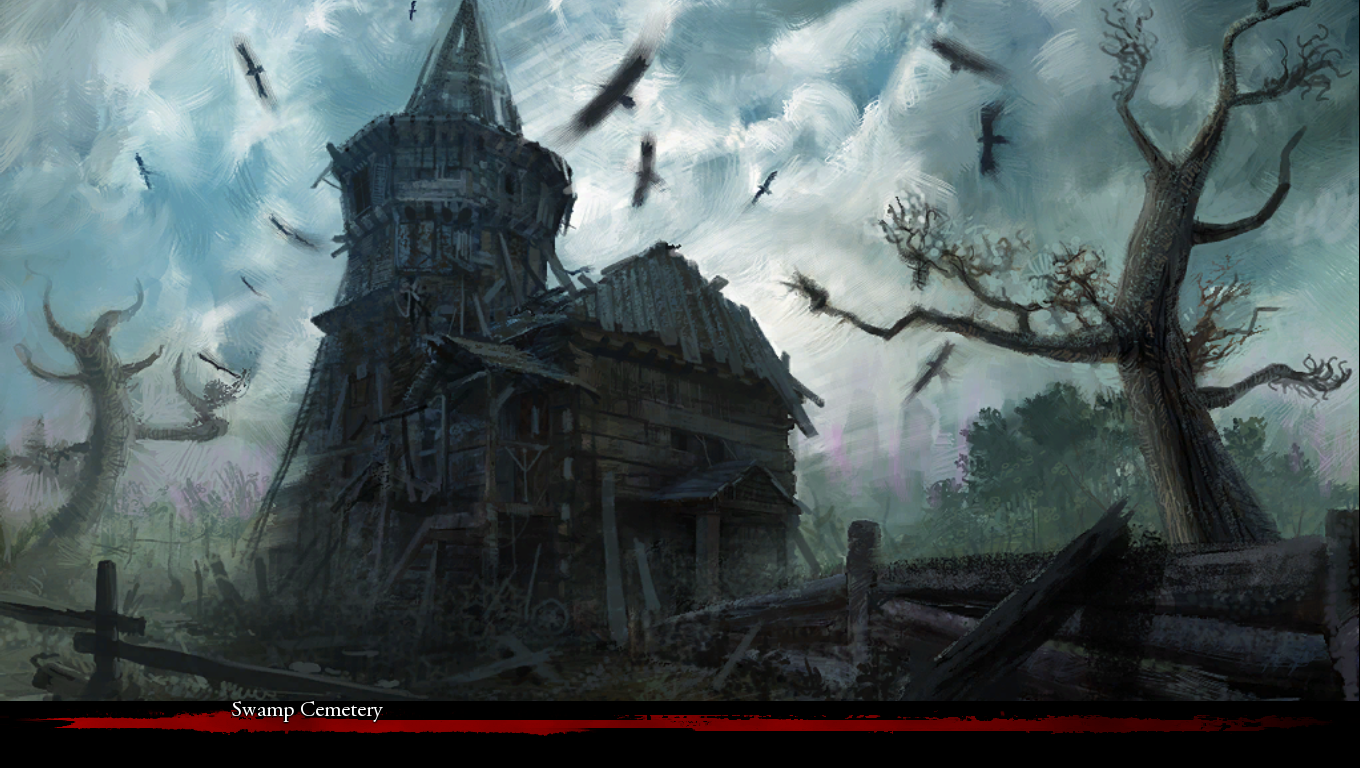
The Swamp Cemetery loading screen.  

Geralt and his horse (never appeared in-game) walking through a village (never appeared in-game).


Monday, October 24, 2016

First Impressions: The Witcher (PC)


This is a (sort of) First Impressions article for the similar reasons that my First Impressions-type post for The Elder Scrolls III: Morrowind took me about 35 hours of gameplay before I felt comfortable putting my time and experience down into words.  So after 22 hours and 29 minutes with The WitcherI wanted to talk a bit about this first game in The Witcher series and not about The Witcher III which more recently came out in May of last year (2015)  This is The Witcher from 2007.

I first started playing a few months back, and even just the game asking a question about control settings took me a bit my surprise.  The question was if I wanted to play with the keyboard/mouse or just the mouse.  My preconception of the game was that it was Skyrim-esque, in that it was a 3rd person, over the shoulder fantasy adventure game set in an open world..  As it turns out, The Witcher could actually be played more like Diablo or Neverwinter Nights, with a semi-isometric camera angle and clicking where you want the protagonist to go.  I decided to use the mouse/keyboard option as I at first didn't know what the "mouse only" option entailed and that was what I became used to in the first area.

One thing I noticed was that your character, Geralt of Rivia, seemed to move a lot faster than the number of footsteps he was taking; it probably also didn't help that in the close up camera mode you are unable to even see Geralt's feet.  In the farther away view (mainly usable in the Mouse mode, but still usable in Keyboard/Mouse), Geralt seems to move more naturally, but I still personally prefer the up close, over the shoulder view.

Something that I love about the game so far, is the visual asthetic to this foreign world.  Maybe because the story of the game is Polish and developed by a Polish company, the game feels more foreign to me than say, The Elder Scrolls IV: Oblivion or even Baldur's Gate.  And even though this world is populated by high fantasy standards such as Elves, Dwarves, werewolves, and wizards, there are flavors such as the names of characters and places, fist fighting in taverns, gambling by dice, and copious amounts and types of alcohol which all lend to  a very eastern European flavor that is not present in other swords and sorcery tales; now I feel like I am stereotyping and I apologize.

There is also a small part of my brain that tells me that I am either not "playing this game correctly" or vastly under-utilizing certain traits and skills in the game such as using magic, and brewing potions and oils.  Only last night did I realize that I missed acquiring a fire spell, something that would be of great use in the swamps and against these damnable plants sporting rotting corpses.  (Next time I play I'm going to see if I can backtrack to the camp where the fire spell was first supposed to be picked up).  I also forgot about how to brew potions and oils since it was briefly covered in the opening area, but I have been collecting everything that I am able to collect to, potentially, brew into a potion. One other area that I am pretty sure that I am deficient in is the money gathering department.  22 1/2 hours in, and I have only had one piece of chestal armor, which is the one that is given to you.  The armorer in the first large city you come to, Vizima, sells a suit of. . .some kind of armor that I'm not 100% sure about, but it costs 5,000 Orens (the unit of currency) and I only seem to have between 1,500 and 2,200 Orens at any given time.

As far as how the game looks and runs, some of the character animations seem off, the clipping of hair/hands/weapons and bodies move around, as well as parts of the character models glitching and extending off into infinity, you know, 2007.  All of these graphical defects aside though, the game is still very much playable and I have yet to come across something that completely hampers my ability to play the game (looking at you Fallout: New Vegas!).

So that is kind of where I am at right now, occasionally sexed, underpaid, under-knowledgeable and frequently killed by that bloody damn stupid carnivorous plant bastard.  I guess I just need to do some more grinding.  LEVEL grinding!  Jeez.


~JWfW/JDub/Jaconian
Instrumental

P.S.  One last thing.  I love how the cities are populated.  You have characters who might typically be found at an inn, but maybe only during a certain time of the day, such as between dusk and midnight because that's when the musicians are playing, but not because the musicians are playing, but music helps to make a atmosphere more conducive to drinking.  Or, a Dwarf might wander between the inn and another named Dwarf's residence because they know each other.  Basically, these fictional digital people have fictional lives of their own (kind of).

P.P.S.  Oh, and another one last thing that I thought was pretty cool which happened when I was out by the docks and it started raining.  Everyone, with exception of the local guards ran from where they would normally be, and all huddled under the overhang of the walkway down to the docks.